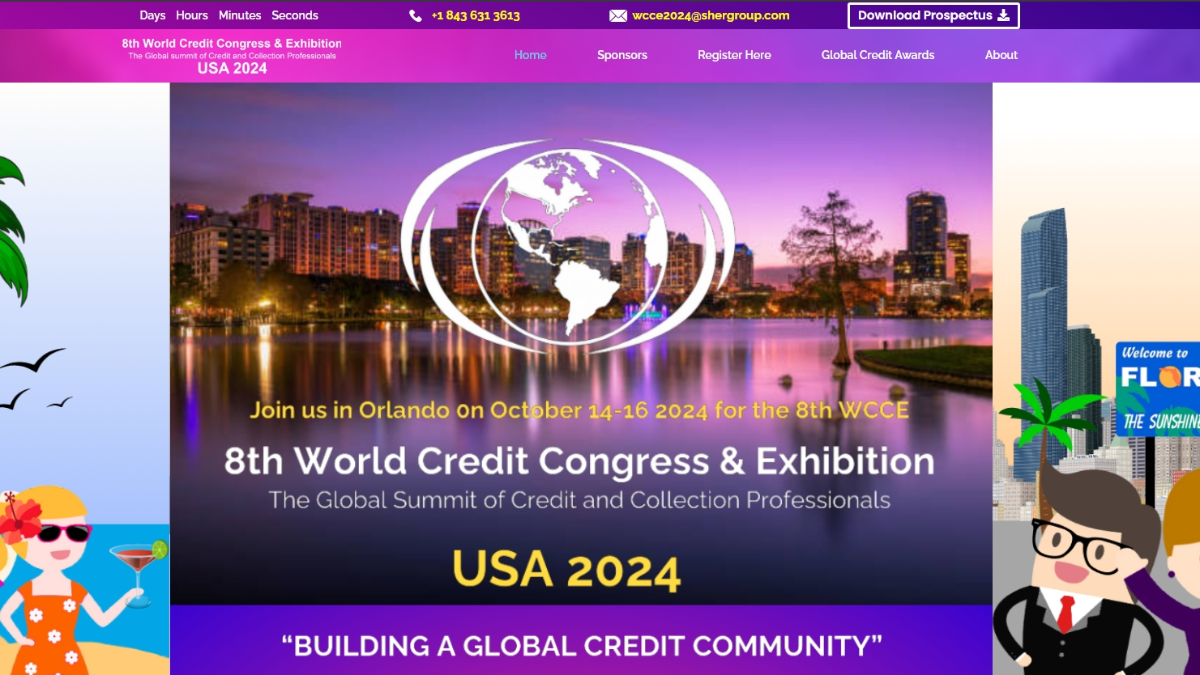
The World Credit Congress & Exhibition is one of the credit industry’s flagship international events. In 2024, it was held in Orlando, Florida — and we were asked to build the promotional website from scratch, along with managing the event’s social media and newsletter campaigns. This was Shergroup Digital’s first event-focused project, and it was a different kind of challenge from anything we had done before.
An event website is not like a business website. It has a fixed deadline, a single objective — get people to attend — and a shelf life. Every decision must serve one goal. There is no time for iteration after launch. You get it right before the event, or you do not get it right at all. That pressure made this project one of the most focused and rewarding we have worked on.
What the World Credit Congress Needed from Its Event Website
The brief was clear: build a visually compelling, immersive website that does two things simultaneously. First, it had to communicate the prestige and scale of the congress — this is a serious, international event for credit professionals, and the site needed to match that weight. Second, it had to sell Orlando as a destination. Attendees were being asked to travel — many internationally — and the site needed to make them feel that the trip would be worth it, both professionally and personally.
That is a balancing act. Too corporate and you lose the energy of the location. Too destination-focused and it starts looking like a tourism brochure instead of an industry event. The site had to hold both ideas at the same time: this is a world-class professional congress, and it is happening in one of the most exciting cities in the US.
What Makes a Good Event Website Different from a Standard Business Website?
An event website has one job: convert visitors into attendees. That changes everything about how you build it. A business website can afford to educate, nurture, and let visitors come back multiple times before they take action. An event website cannot. The visitor needs to understand what the event is, who it is for, why they should attend, and how to register — all in a single session. Navigation must be effortless. The value proposition must land in the first few seconds. And the design must create a feeling — anticipation, excitement, trust — that words alone cannot deliver. That is why event website design for conferences is its own discipline. The rules are different because the stakes are compressed into a much shorter window.
How We Designed an Immersive Experience for the WCCE 2024 Website
We approached the site as a story in two halves. The first half was the congress itself: the program, the speakers, the exhibition, the networking opportunities. This content needed to be structured clearly so that a credit professional landing on the site could immediately see the caliber of the event and understand what they would gain by attending. We organized everything around the visitor’s decision-making process — not around the organizer’s internal structure.
The second half was Orlando. We built out destination content that showcased the city as a host location — not with generic tourism copy, but with practical, appealing information that answered the unspoken question every potential attendee was asking: “If I’m going to fly to Florida for this, what else is in it for me?” The imagery was central to this. We selected and placed visuals that captured Orlando’s atmosphere — the climate, the venues, the energy of the city — so the site felt less like a registration form and more like an invitation.
The design language was deliberately premium. Clean layouts, strong typography, high-quality imagery, and generous spacing. Every element was there to reinforce the same message: this is a prestigious, well-organized event worth attending. Nothing was filler. If a section did not help someone decide to register, it did not make the cut.
Running Social Media and Newsletter Campaigns for a Major Industry Conference
The website was a hub, but it could not do the job alone. Event social media management is about building momentum — creating a sense of anticipation that grows as the event date approaches. We managed the WCCE 2024 social channels on Facebook and Instagram, building a content calendar designed around the event timeline.
Early posts focused on awareness — what the congress is, who attends, why it matters. As the date approached, content shifted toward urgency and specifics: speaker announcements, program highlights, early-bird deadlines, and destination teasers. Every post is linked back to the website. Every piece of content had a job: drive registrations.
The newsletter campaigns followed the same arc. We designed and managed email sequences targeting credit professionals and industry businesses, each timed to coincide with key milestones — program announcements, registration deadlines, and final reminders. The newsletters were not generic blasts. Each one was crafted to give the reader a specific reason to register now rather than later. Conference digital marketing only works when every channel reinforces the same message at the same time, and that is exactly how we ran it.
How Do You Promote a Conference Using Digital Marketing?
You start with the website as the conversion point and build every other channel around it. Social media creates awareness and anticipation. Newsletters deliver targeted information to people already in your pipeline. The website closes the deal. For the World Credit Congress, we ran all three channels as a connected system: social posts drove traffic to the site; the site captured interest, and newsletters followed up with people who had not yet registered. Every touchpoint reinforces the same core message — this event is worth your time and your travel — and every touchpoint pointed to the same destination: the registration page.
What the WCCE 2024 Project Proved About Event Digital Marketing
This was our first event website, and it validated something we had believed but had not yet tested: the same system-driven approach we use for ongoing business clients works just as well for time-limited, event-focused projects. The website delivered a premium, immersive experience that matched the prestige of the congress. The social channels built steady momentum in the weeks leading up to the event. And the newsletter campaigns hit the right people with the right message at the right time.
The event was held successfully in Orlando in 2024, and the digital presence we built played a real part in driving attendance and visibility. You can still see the social presence we built on Facebook and Instagram.
What This Means If You are Planning a Conference, Exhibition, or Industry Event
If you are organizing a professional event and your digital presence is an afterthought — a basic landing page, a few social posts, and a mass email — you are leaving registrations on the table. Event attendees make decisions based on how professional and compelling the event looks online, long before they experience the event itself. Your website is your first impression, your social channels build the anticipation, and your newsletters close the gap between interest and commitment.
The WCCE project showed us that the Forever Traffic system adapt naturally to event-based work. The channels are the same — website, social, email — but the timeline is compressed, and the objective is singular: fill the room. If you are running an event and want the digital side handled properly, this is the kind of project we now know we can deliver.
What Should an Event Promotional Website Include?
At minimum: a clear description of the event, the program or agenda, speaker or exhibitor information, the venue and destination, registration details, and strong imagery that sets the tone. But the difference between a functional event website and an effective one is design and structure. The site needs to create a feeling — anticipation, credibility, excitement — and guide every visitor toward one action: registering. If someone must hunt for the registration button or cannot quickly understand what the event offers, you have already lost them.
The WCCE 2024 Takeaway
Event website design for conferences is a different discipline from building a business website, but the underlying principle is the same: every channel works harder when it is part of a system. The World Credit Congress & Exhibition gave us the chance to prove that our approach scales beyond ongoing client accounts into focused, deadline-driven projects — and it delivered.
If you are organizing an event and want a digital presence that matches the quality of what you are putting on, we would welcome the conversation.
- Book a free Digital Marketing Audit and we will map out what the digital strategy would look like for your event.
- Download the Genie Solution Brochure to see how the Forever Traffic system works — for businesses and events.
- Or get in touch directly — we would love to hear about what you are planning.
FAQ Section
How far in advance should you launch an event website?
Ideally, your event website should be live at least three to six months before the event date. This gives you time to build search visibility, run social media campaigns, and execute email sequences with multiple touchpoints. Launching too late means you are relying entirely on direct outreach and paid advertising, which is more expensive and less sustainable than organic channels.
Can a digital marketing agency handle both the website and social media for an event?
Yes, and it is usually better when one team handles both. For the WCCE 2024, Shergroup Digital managed the website, social media, and newsletter campaigns as a connected system. When channels are managed separately, messaging drifts and timing fall out of sync. A single team ensures everything reinforces the same message and drives toward the same goal: registration.
How do you promote a conference on social media?
Build a content calendar tied to the event timeline. Start with awareness content — what the event is, who it is for, why it matters. Then shift to specifics as the date approaches: speaker announcements, program highlights, destination teasers, and deadline reminders. Every post should link to the event website. Use platform-specific formatting and keep the content varied enough to avoid fatigue.
What is the most important page on an event website?
The homepage. It is where most visitors land, and it needs to communicate the event’s value, date, location, and how to register within seconds. If the homepage does not immediately answer “What is this event and why should I attend?” most visitors will leave before exploring further. Strong imagery, clear headline, and visible registration path are non-negotiable.
Do event newsletters drive registrations?
They do when they are timed properly, and each send has a specific purpose. A newsletter that says “the event is coming” will not convert. A newsletter that announces a keynote speaker, highlights a new program track, or reminds the reader of an early-bird deadline gives them a concrete reason to act. For the WCCE, we timed send to coincide with key milestones, and each one gave the reader something new to consider.
Comments are closed