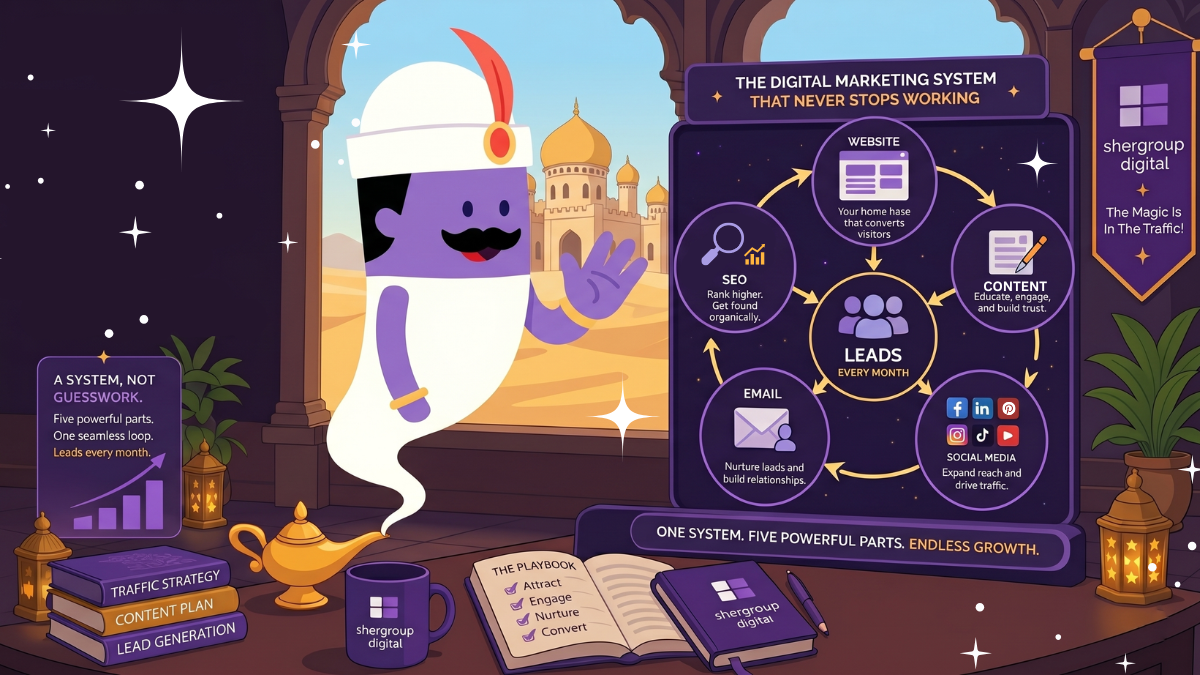
Building a digital marketing system for your small business means creating a structured set of connected activities — SEO, content, email, and social — that generate leads continuously, not just when you’re running ads. Most small
businesses spend money on marketing without a system behind it, which means results stop the moment the spending stops. A properly built system compounds over time — each month building on the last.
This is not a new idea. The concept of perpetual, system-driven traffic has been at the heart of the most
successful digital marketing thinking for over a decade. What is new is how accessible the system has
become for small businesses — and how clearly the gap has widened between businesses that have
built it and those still relying on ad spend, word of mouth, or occasional social posts to stay visible.
Why One-Off Marketing Activity Never Builds a Sustainable Pipeline
The pattern is familiar. A business runs a Google Ads campaign, gets some enquiries, pauses the
campaign when the budget runs out, and the enquiries stop. Or they pay for a website redesign, wait for
traffic that never materialises, and conclude that digital marketing doesn’t work for businesses like
theirs.
It is not that the individual activities are wrong. It is that they are disconnected. Ads without content
means you stop being visible the moment you stop paying. Content without SEO means nobody finds it.
SEO without a clear conversion path means traffic arrives and leaves without becoming a lead. Social
media without email capture means followers who never become customers.
A system joins these components up. Each one feeds the next. Your content improves your SEO
rankings. Your rankings bring in organic traffic. Your traffic converts to email subscribers. Your email list
brings repeat visitors and referrals. The whole structure gets stronger every month — not because
you’re spending more, but because each component is doing its job.
What Does a Digital Marketing System for a Small Business Actually Look Like?
A properly built system for an SMB has five connected layers:
1. A website built to convert, not just to exist
Most small business websites are digital brochures
— they describe what the business does but do not actively work to capture enquiries. A system
starts with a website that has clear calls to action, fast load times, and pages structured around the
keywords your customers actually search for.
2. SEO that targets the right keywords
Not hundreds of keywords — the right ones. For most
small businesses, ten to fifteen well-chosen keywords, consistently targeted through structured
content, will drive the majority of valuable organic traffic.
3. Content that builds authority over time
Blog posts, guides, and case studies that answer the questions your customers are already asking — signalling to Google that your site is authoritative and giving potential customers the confidence to enquire before they have even spoken to you.
4. Email that keeps your community warm
Not a newsletter sent when you remember — a structured communication going out regularly to everyone who has ever shown interest in your business. The most underused component in most small business marketing, and often the highest-returning.
5. Social media that amplifies, not replaces
Posts that distribute your content, reinforce your authority, and bring people back to your website. Connected to the rest of the system, it multiplies the impact of everything else.
This is exactly the architecture behind Shergroup Digital‘s Forever Traffic programme — a ten-step
system built on this framework, done for you from the ground up.
How Do You Build Each Component of the System?
Start with the foundation and build outward. The sequence matters:
1. Fix the website first
Speed, mobile experience, and clear calls to action are non-negotiable starting points. Every other component sends traffic back here — if it does not convert, the rest of the system is working against itself.
2. Identify your top ten keywords
Focus on keywords with clear commercial intent — “web design agency Florida” or “SEO for small businesses UK” rather than generic terms with high competition and low conversion.
3. Build a content calendar around those keywords
Map each piece to a specific search question, write it to answer that question directly, and publish on a consistent schedule.
4. Set up email capture and a regular newsletter
A simple lead magnet placed on your website will begin building your email list immediately. A monthly newsletter keeps your business front of mind.
5. Distribute every content piece across your social channels
A blog post becomes three social posts, a short video script, and an email section. The system creates the content once and uses it everywhere.
Property Fixology in Florida and Yankee Dumpster in Connecticut both followed this framework through
Shergroup Digital’s Forever Traffic programme. Neither had a structured digital marketing system before
we started. Both now have websites that rank for their core service keywords, a content pipeline that
publishes consistently, and an email list that generates repeat enquiries.
How Long Before a Digital Marketing System Starts Generating Consistent Leads?
The honest answer is three to six months before the system reaches full momentum — but meaningful
results come earlier. In the first month, foundation work produces immediate improvements: faster
website, better structure, clearer conversion paths. By months two and three, content begins to index
and rank. From month four onward the compounding effect kicks in — domain authority builds, the
email list grows, and leads arrive with increasing regularity.
The key is consistency. A system that runs for twelve months builds an asset that continues to generate
leads indefinitely. A system that pauses after three months will not compound.
Do You Need to Build the System Yourself or Can Someone Do It for You?
You can build it yourself — the components are not technically complex. The challenge is time,
consistency, and the expertise to make each component work together rather than in isolation. Most
small business owners have the intent but not the bandwidth.
The businesses that succeed either have a dedicated in-house marketing resource or work with an
agency that builds and runs the system on their behalf — faster, more consistent, and in most cases
more cost-effective than building it yourself through trial and error.
Frequently Asked Questions
What is the difference between a digital marketing strategy and a digital marketing system?
A strategy is a plan — it defines your goals, audience, and approach. A system is the operational structure
that executes that strategy consistently over time. Most small businesses have a rough strategy but no
system, which is why results are inconsistent. The system turns strategy into compounding results.
How much should a small business spend on building a digital marketing system?
A realistic budget for a done-for-you digital marketing system starts at around £500–£1,000 per month in
the UK or the US equivalent. The return — organic traffic, leads, and repeat enquiries without ongoing ad
spend — typically outperforms paid advertising within six to twelve months.
Can a small business build a digital marketing system without a big team?
Yes. The Forever Traffic framework is designed for small businesses without in-house marketing teams. It
runs efficiently with minimal ongoing input from the business owner — typically a monthly check-in and
content approval rather than daily management.
What is the most important part of a digital marketing system to build first?
Your website. Everything else in the system — SEO, content, social, email — sends traffic back to your
website. If the website does not convert visitors into enquiries, the rest of the system is working against
itself. Fix the foundation before building everything else.
How do I know if my digital marketing system is working?
Three metrics tell you what you need to know: organic traffic (are more people finding you through
search?), conversion rate (are visitors becoming enquiries?), and lead source (are new customers telling
you they found you online?). A monthly SEO rankings report and Google Analytics will show you all three.
Ready to get started?
Ready to stop guessing at digital marketing and start running a system that builds every month?
Shergroup Digital’s Forever Traffic programme builds the entire system for you — from website to
keywords to content to reporting. Get started:https://shergroupdigital.com/contact-us/ or Book a free Digital Marketing Audit and we will show you what this system would look like for your.
Comments are closed